
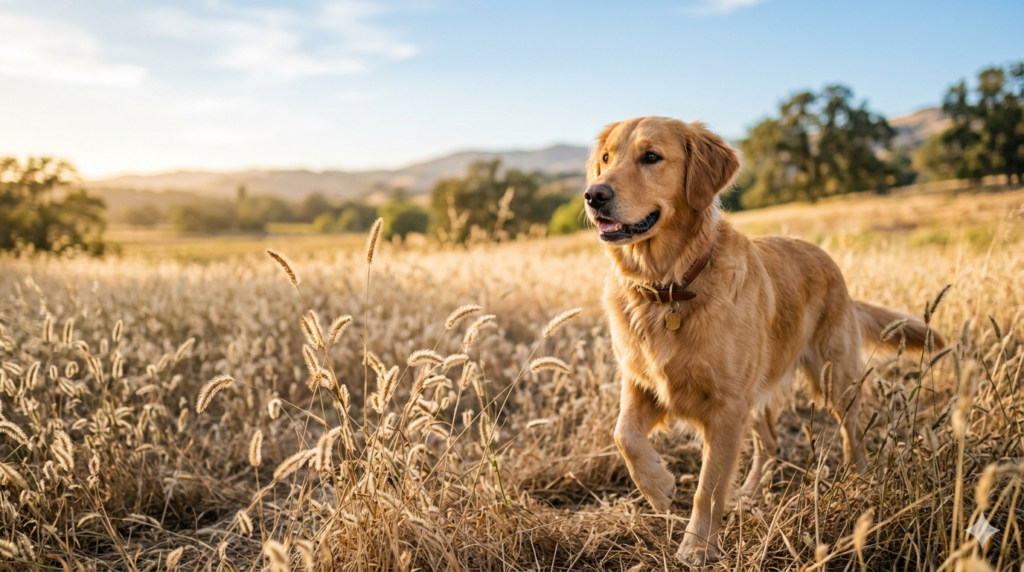
Every spring, Central Valley dogs return from their walks with stickers in their fur, paws, and ears — and many of those harmless-looking seed heads are actually foxtails. Foxtails in dogs are one of the most common warm-weather injuries we treat at our Stockton vet clinic, and what starts as a tiny grass awn lodged between two toes can turn into an abscess, a chronic ear infection, or even a life-threatening migration into the lung. This guide walks you through what these plants look like, where they hide on your dog, how to safely respond, and how to keep your pet out of the exam room during foxtail season.
What Are Foxtails and Why They’re So Dangerous
Foxtails are the dried seed heads of certain wild grasses — most commonly Hordeum murinum (wall barley) and Bromus species — that thrive across California’s open lots, hiking trails, hayfields, and unmown lawns. Each seed has microscopic backward-pointing barbs that act like fishhooks. Once a foxtail attaches to fur or skin, it can only travel in one direction: deeper.
Unlike a thorn or a piece of glass, a foxtail will not work its way back out. Dogs’ bodies cannot dissolve or absorb the plant material. Left alone, the awn burrows through skin, into ear canals, up nasal passages, and in severe cases through soft tissue into the chest cavity, abdomen, or spine. According to the UC Davis School of Veterinary Medicine, foxtail migration can result in serious infections requiring surgical intervention if not addressed early. This one-way travel is what makes foxtails uniquely hazardous compared with other plant injuries.
Foxtail Season in California: When the Risk Peaks
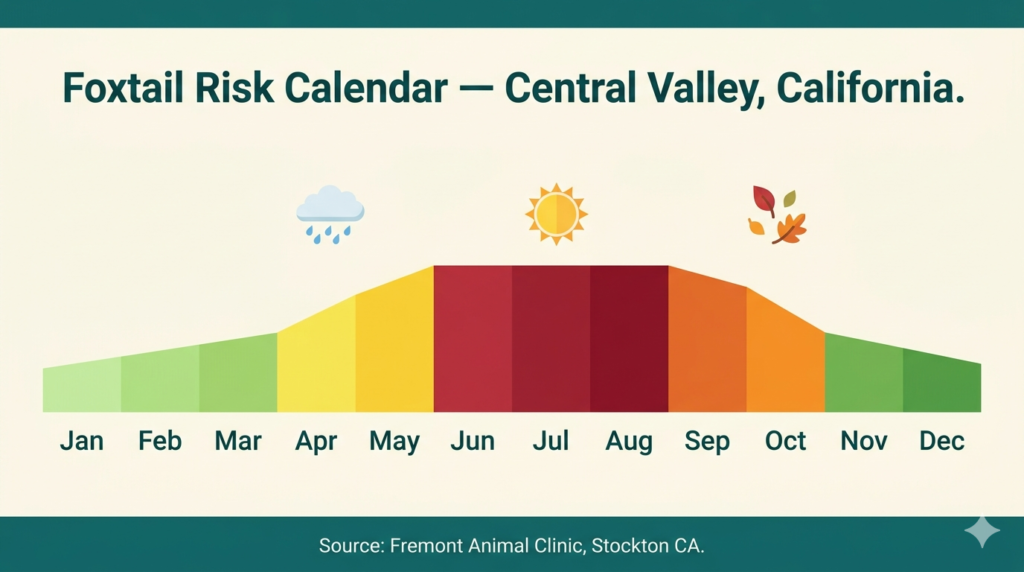
In the Central Valley, foxtail season typically runs from late April through October, with the highest concentration of cases between June and September when grasses dry out and shed their seed heads. Stockton, Lodi, Tracy, and the surrounding farming communities all see elevated foxtail exposure because of irrigated fields, levees, and the abundance of dry annual grasses along walking trails. Heavy spring rains followed by hot, dry summers — the classic California pattern — produce especially heavy foxtail crops.
If you walk your dog in tall grass, near vacant lots, along the Calaveras River, or anywhere off-leash in the foothills, you should treat every warm-weather walk as potential foxtail exposure.
Quick visual ID: A foxtail looks like a tan or golden seed head, roughly half an inch to two inches long, with a feathery, arrow-shaped tip. The pointed end is sharp; the trailing barbs lay flat. Crush one between your fingers and you will feel why it grabs onto fur so easily.
Where Foxtails Hide on Your Dog: Symptoms by Body Part
Foxtails do not announce themselves. Most owners discover the problem days later, when their dog starts behaving oddly. Here is what to watch for, area by area.
Foxtail in Dog Paw
The space between toes is the most common landing spot. A foxtail in dog paw typically causes:
- Persistent licking or chewing at one specific paw
- A swollen, red lump between the toes (often draining clear or bloody fluid)
- Limping that comes and goes
- A small puncture or “weeping” hole in the webbing
Long-coated breeds — golden retrievers, cocker spaniels, Aussies, doodles — are especially vulnerable because the awn gets trapped in the feathering and pushed into the skin with each step.
Foxtail in Dog Ear
A foxtail in dog ear is usually obvious because dogs cannot ignore it. Signs include:
- Sudden, violent head shaking
- Tilting the head to one side
- Pawing or scratching at the affected ear
- Crying out when the ear is touched
- A foul smell or discharge if the foxtail has been in place several days
Foxtails can travel down the ear canal and rupture the eardrum, so this symptom set should not be left untreated. Same-day evaluation through our veterinary urgent care is the right call.
Foxtail in Dog Nose
A foxtail in dog nose triggers an unmistakable response: explosive, repeated sneezing that comes on suddenly, sometimes with a small amount of blood from one nostril. The dog may paw at their face or rub their nose along the carpet. Without removal, the awn can migrate into the sinuses or even back into the throat.
Foxtail in Dog Eye
Squinting, excessive tearing, redness, and pawing at one eye are classic signs of an awn lodged under the eyelid or in the conjunctiva. This is a true ocular emergency — corneal damage can occur within hours, and the ASPCA Animal Poison Control and most veterinary emergency guidelines list eye injuries among the top time-sensitive concerns in dogs.
Foxtails in the Mouth, Throat, or Chest
Dogs that sniff or chew grass can inhale or swallow foxtails. Symptoms include gagging, a sudden cough that does not go away, drooling, or refusing food. Inhaled foxtails that reach the lungs can cause pneumonia or pyothorax (pus in the chest cavity), which require advanced imaging and surgery to resolve. Research summarized by the Cornell University College of Veterinary Medicine underscores that early detection of inhaled foreign bodies dramatically improves outcomes.
How to Remove a Foxtail from Your Dog Safely
The honest answer: you should only remove a foxtail at home if it is clearly visible, sitting loose in the fur, and has not yet broken the skin.
For a surface-level awn caught in the coat:
- Use blunt-tipped tweezers, gripping the foxtail by its base.
- Pull straight out in one smooth motion — never twist.
- Inspect the area for a puncture, redness, or any remaining plant fragment.
- Clean the spot with a mild antiseptic and watch for swelling over the next 48 hours.
Do not attempt to dig out a foxtail that has already entered the skin, the ear canal, the nose, or the eye. Pieces almost always break off, and the buried fragment will keep migrating. Sedation, magnification, and proper instruments are required for safe extraction. If the awn is deep, our team uses our in-house lab to confirm location and rule out infection before removing it under anesthesia.
Foxtail Dangers in Dogs: Complications You Shouldn’t Ignore
When a foxtail goes untreated, the complications stack up quickly:
- Abscesses and cellulitis at the entry site
- Chronic ear infections and ruptured eardrums
- Discospondylitis (spinal infection) when awns migrate along soft tissue planes
- Pneumothorax or pyothorax if a foxtail reaches the lungs
- Vision loss from corneal ulceration
- Surgical extraction through deeper tissue, sometimes requiring pet surgery in Stockton CA to track and remove a migrated awn
The earlier a foxtail is found, the simpler the fix. The longer it travels, the more invasive the treatment becomes.
A Real Stockton Case: How One Foxtail Turned Into a Two-Week Problem
A local family brought in a four-year-old Labrador after noticing he had been licking his right front paw for three days. There was a small, swollen bump between his middle toes — about the size of a pea — and a tiny puncture wound that kept reopening. The owners thought he had stepped on something sharp at a city park near the river.
On exam, sedation was needed to probe the wound. A foxtail measuring just over an inch had migrated nearly two centimeters under the skin, traveling toward the metacarpal pad. The awn was extracted intact, the wound was flushed and closed, and the dog went home on a short course of antibiotics. Total recovery: ten days. Had the family waited another week, the awn would likely have reached the joint and required orthopedic intervention.
This kind of case is routine here from May through October — and the outcome almost always depends on how quickly the dog is seen.
At-Home Removal vs. Veterinary Removal: What’s the Difference?
| Situation | At-Home Approach | Veterinary Care Required |
|---|---|---|
| Foxtail loose in coat, no skin contact | Tweezers, brush out | Not needed |
| Foxtail in paw webbing, surface only | Remove if visible and undamaged | Yes, if any swelling appears |
| Foxtail in ear canal | Do not attempt | Immediate sedated otoscopy |
| Foxtail in nose | Do not attempt | Same-day rhinoscopy |
| Foxtail in eye | Do not attempt | Emergency exam |
| Puncture wound, draining, swollen | Do not probe | Sedated exploration and flush |
| Sudden coughing or gagging | Monitor briefly | Imaging if symptoms persist |
When in doubt, call. A five-minute phone consultation costs nothing and often prevents a thousand-dollar surgery.
How to Prevent Foxtails in Stockton and the Central Valley
Prevention is far cheaper than treatment, and most strategies are simple:
- Walk routes matter. Stick to mowed paths, paved trails, and irrigated parks. Avoid vacant lots, dry hillsides, and trail edges from June through September.
- Inspect your dog after every outdoor outing. Run your fingers through the coat, between every toe, inside the ear flaps, and around the muzzle and armpits. Two minutes of checking saves hours in the exam room.
- Keep your own yard mowed. Let foxtail grasses dry and you’ve created a hazard zone at home. Cut early, cut often, and bag the clippings.
- Trim long-coated breeds. A summer trim — particularly the paw feathering and ear fringe — gives foxtails fewer places to grab.
- Use a foxtail field hood or protective boots. For dogs that hike or hunt, mesh hoods (like the Outfox Field Guard) and lightweight boots dramatically reduce exposure. The American Veterinary Medical Association notes that physical barriers remain the most effective prevention against grass awn injuries in working and field dogs.
- Build a relationship with a vet near me in Stockton so that when something looks off, you already have a record on file and can be seen quickly.
Routine preventive pet screening during the spring wellness visit is also a good time to talk through a foxtail prevention plan tailored to your dog’s coat, breed, and lifestyle.
When to Call a Vet vs. Wait It Out
Any of the following warrants a call to (209) 465-7291 today, not tomorrow:
- Repeated, violent head shaking
- Sudden, persistent sneezing
- Squinting, tearing, or pawing at one eye
- A swollen, draining bump on a paw
- A cough that comes on suddenly and does not resolve in a few hours
- Visible plant material you cannot remove cleanly
For deeper skin issues that may be confused with foxtail wounds — hot spots, allergies, secondary infections — our veterinary dermatology services can help differentiate and treat.
For more after-hours guidance, our complete emergency vet near me walkthrough explains what to do when something happens outside regular appointment windows.
Frequently Asked Questions
-
How long can a foxtail stay in a dog before causing serious harm?
A foxtail can begin migrating within hours of attaching to the skin or entering a body cavity. Most serious complications develop within three to ten days, depending on location. Awns in the nose or ear cause symptoms almost immediately, while paw foxtails may go unnoticed for several days before swelling appears. The takeaway: there is no safe waiting period. Earlier removal almost always means simpler treatment and faster recovery for your dog.
-
Are some dog breeds more vulnerable to foxtails than others?
Yes. Long-haired and long-eared breeds — golden retrievers, cocker spaniels, springer spaniels, Aussies, doodles, and any heavily feathered dog — are at higher risk because their coats trap awns easily. Short-nosed breeds may cough up inhaled foxtails more readily, but they are not immune. Active dogs that hike, hunt, or run off-leash in the Central Valley face the greatest exposure regardless of breed, simply because of where they spend their time.
-
Can I just leave a small foxtail in my dog’s paw and let it work its way out?
No. Foxtails have backward-facing barbs that prevent them from reversing direction once embedded. Unlike splinters, they will not naturally surface or dissolve. Leaving one in place almost guarantees deeper migration, infection, and a more invasive removal procedure later. If you suspect a foxtail is under the skin and you cannot see it clearly, schedule a same-day exam rather than waiting to see what happens.
-
What does a foxtail wound look like once it gets infected?
An infected foxtail wound usually appears as a small, raised lump with a central puncture or draining tract. The skin around it is often red, warm, and tender. You may see clear, bloody, or yellow discharge, and the dog will often lick the area persistently. In some cases, the original entry point closes over while infection builds underneath, creating an abscess. Any draining lump in foxtail season should be evaluated promptly.
-
Is foxtail exposure worse in Stockton than in other parts of California?
Stockton sits in the heart of foxtails Central Valley territory, where irrigated farmland, levees, dry annual grasses, and warm summers create ideal foxtail conditions from late spring through fall. Cases here typically peak earlier and last longer than in cooler coastal regions. Local parks, riverbanks, and rural walking trails all carry meaningful risk. Pet owners across San Joaquin County should treat foxtail prevention as a seasonal routine, not an occasional concern.
-
How can I check my dog for foxtails after a walk?
Start at the head and work backward: look inside each ear flap, around the eyes, and along the muzzle. Then check the chest, armpits, belly, and groin. Finish with each paw, spreading the toes apart to inspect the webbing. Running your fingers against the grain of the coat helps you feel embedded seed heads. The whole inspection takes about two minutes and prevents most serious foxtail problems.
Foxtails in dogs are seasonal, predictable, and largely preventable — but they demand respect. If you see the signs, do not wait. Call Fremont Animal Clinic at (209) 465-7291 to get your dog seen the same day.